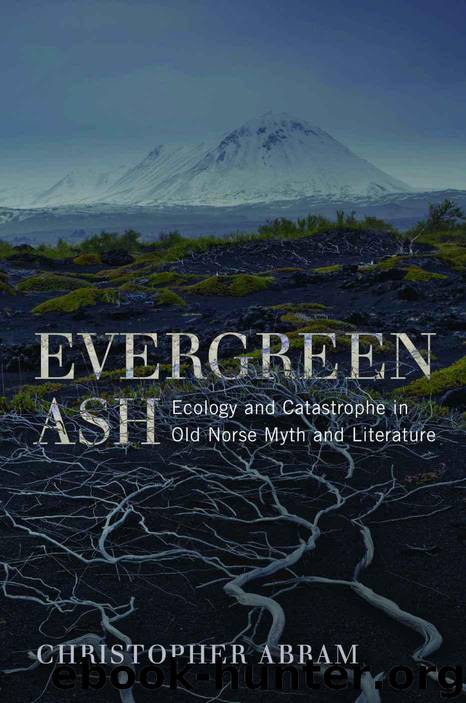
Evergreen Ash (Under the Sign of Nature) by Abram Christopher
Author:Abram, Christopher [Abram, Christopher]
Language: eng
Format: azw3
Publisher: University of Virginia Press
Published: 2019-02-05T16:00:00+00:00
6. The Æsir and the Anthropocene
The Vínland sagas hold out the possibility of a perfect naturecultural existence in the North Atlantic that turns out to be an illusion, an impossibility, a paradise that may never be regained. They conform, therefore, to one of the master paradigms of Western mythology—the story of the Fall, of mankind’s decline from a state of grace or even divinity in which Nature served our needs unbidden. The Norse myths proper adhere to very similar narrative patterns. The trajectory of the pagan cosmos traces a steeply declining arc from an always already lost state of perfection to an apocalypse in which all existing structures of human society are swept away in the expectation that a new and improved world will become possible in the wake of the old world’s death. A better world will rise, phoenixlike, from the ashes of our worn out, moribund, sinful civilizations. These apocalypticisms have clear resonances with ideas about the anthropogenic ecological collapse that threatens to bring about the end of all our casual and complacent conceptions of what human society is or can be in the twenty-first century. Many of us believe that we are on the edge of a precipice right now, that the end of the world, of our world, is imminent, and that it is the business of ecocriticism to help us prevent or simply survive the catastrophe. In this chapter and the one that follows, I discuss how the Norse gods, upon finding themselves in precisely the same type of crisis that we are in, are constitutionally incapable of taking any action that prevents Ragnarǫk, the “fate of the divine powers,” or “doom of the gods,” as the Norse apocalypse is called. The gods’ fate is to repeat and amplify the mistakes that create the conditions in which the world inevitably will end. Trapped in a hole of their own design, the gods keep digging. The gods, I will argue, are strikingly modern in the futility of their response to naturecultural collapse: the worse things become in the world, the more tightly the Æsir cling to the structures that have caused this collapse; the more they invest in propping up their old way of life, the more impossible becomes the task of preventing its bloody and fiery demise. The myth of Ragnarǫk is, in effect, the myth of modernity, of human progress, of the Anthropocene.
Just as J. L. Schatz suggests they must, ecocritics and environmental activists frequently deploy ideas and images of apocalypse in their work: “We cannot motivate people to change the ecological conditions that give rise to thoughts of theorization without reference to the concrete environmental destruction ongoing in reality. This means that, even when our images of apocalypse aren’t fully accurate, our use of elements of scientifically-established reality reconstructs the surrounding power structures in beneficial ways.”1 A critical movement inspired by crisis mobilizes the rhetoric of the ultimate crisis in an attempt to effect the changes that may, in fact, prevent the crisis from ever fully coming to pass.
Download
This site does not store any files on its server. We only index and link to content provided by other sites. Please contact the content providers to delete copyright contents if any and email us, we'll remove relevant links or contents immediately.
4 3 2 1: A Novel by Paul Auster(12377)
The handmaid's tale by Margaret Atwood(7757)
Giovanni's Room by James Baldwin(7330)
Asking the Right Questions: A Guide to Critical Thinking by M. Neil Browne & Stuart M. Keeley(5762)
Big Magic: Creative Living Beyond Fear by Elizabeth Gilbert(5757)
Ego Is the Enemy by Ryan Holiday(5417)
The Body: A Guide for Occupants by Bill Bryson(5082)
On Writing A Memoir of the Craft by Stephen King(4936)
Ken Follett - World without end by Ken Follett(4723)
Adulting by Kelly Williams Brown(4567)
Bluets by Maggie Nelson(4548)
Eat That Frog! by Brian Tracy(4526)
Guilty Pleasures by Laurell K Hamilton(4440)
The Poetry of Pablo Neruda by Pablo Neruda(4098)
Alive: The Story of the Andes Survivors by Piers Paul Read(4023)
White Noise - A Novel by Don DeLillo(4006)
Fingerprints of the Gods by Graham Hancock(3996)
The Book of Joy by Dalai Lama(3976)
The Bookshop by Penelope Fitzgerald(3844)
